Showing posts with label Wi-Fi. Show all posts

Thursday, 25 July 2019

Wireless Radiation: New Awareness Campaigns Launched by Cyprus and Italy

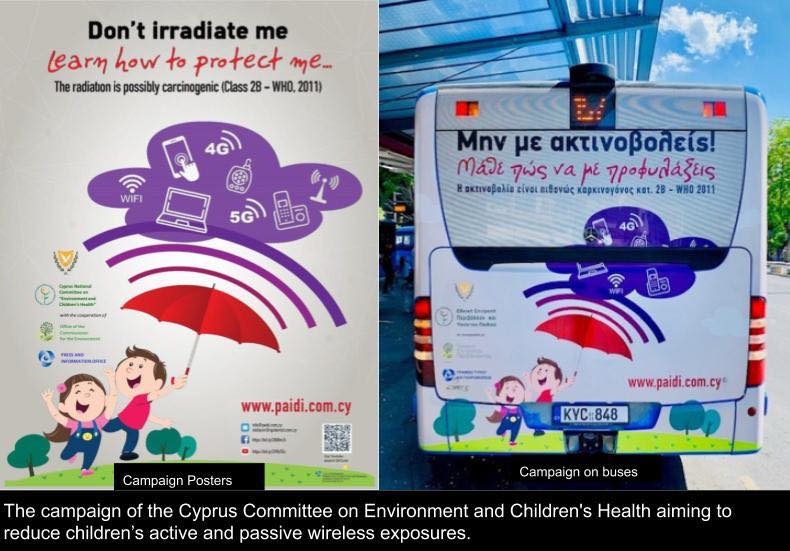
Compare the awareness campaign on environmental and health impacts of mobile phone use recently launched by the Italian Government with that of Cyprus regarding how to reduce wireless radiation exposures.

Cyprus 
Environmental Health Trust 24 June 2019


Cyprus has launched an awareness campaign to educate the public on how to reduce wireless radiation exposures. The campaign includes large scale signs on pubic buses with the slogan “Don’t Irradiate Me: Learn How to Protect Me” along with posters, brochures and videos translated into both Greek and English.

The Campaign was launched at a press conference June 24, 2019 with recommendations include simple advice on how to protect children at home


Read more »

Thursday, 30 May 2019

Video Interview with Professor Martin Röösli, President of the Swiss Advisory Expert Group NIS (BERENIS)

Video interview with Professor Martin Röösli
schutz-vor-strahlung.ch, 29 May 2019 - translation
[All interviews are in Swiss German.]

Professor Martin Röösli
Martin Röösli is Professor in Environmental Epidemiology at the Tropical Institute in Basel and also a member of  ICNIRP.  He also presides over the Advisory Expert Group NIS (BERENIS), which works for the Federal Office for the Environment (FOEN), and continues to work in the "Mobile Communications and Radiation" working group, which is mandated by the Confederation. We were allowed to interview him.

WLAN [Wi-Fi] and the detectability of electrosensitivity

We wanted to know why Prof. Röösli considers WLAN to be negligible, because building biologists have been recognizing WLAN as a disturbing factor for a good night's sleep for years.

"If it were possible to prove electrosensitivity only once, that would question the whole model of thinking." 
- Martin Röösli, epidemiologist and FOEN consultant
According to a 2004 survey , 5% of respondents said they were electrosensitive. According to another survey in 2009 , it was 8.6%. An additional increase in the number of persons affected by 2019 is to be expected. Around 800,000 people in Switzerland are therefore likely to react sensitively to electrosmog today. Nevertheless, Prof. Röösli finds no scientific proof of electrosensitivity.
Read more »